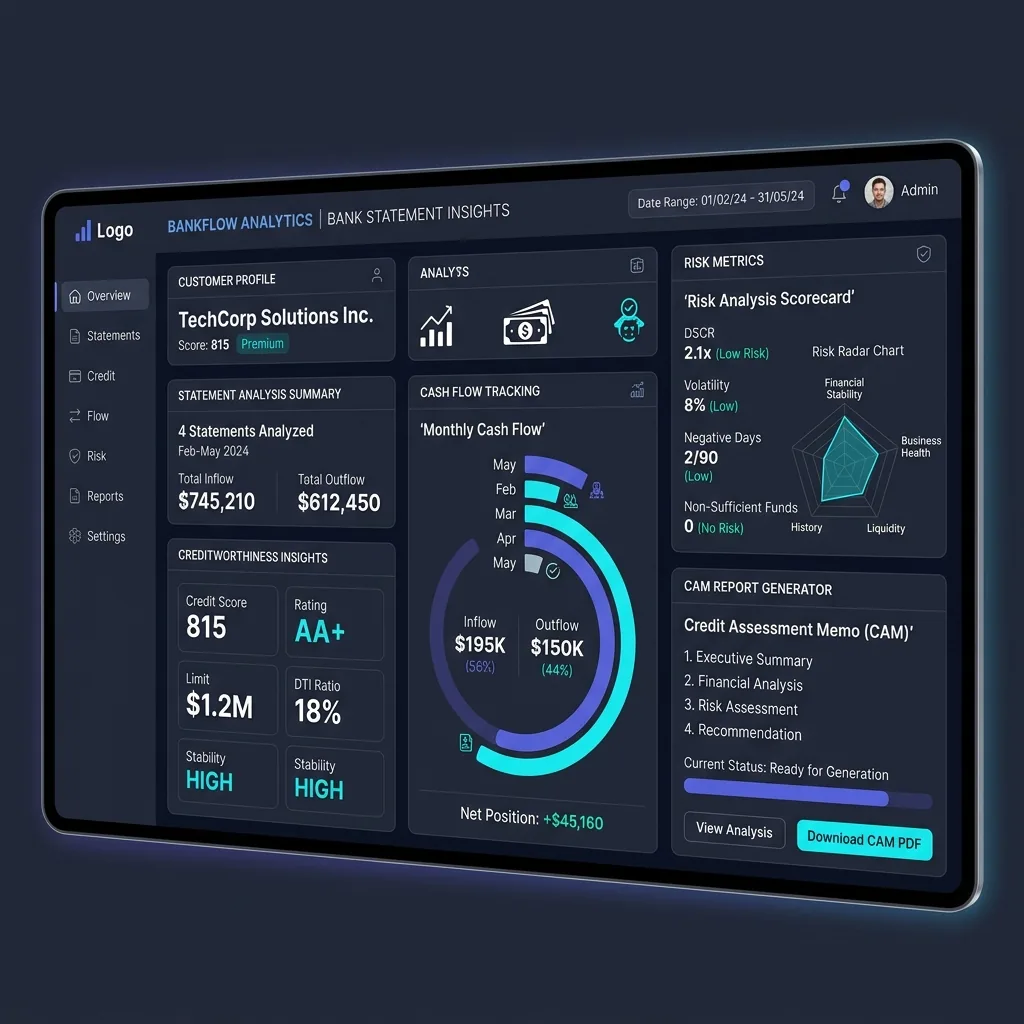
In commercial and retail banking, the CAM full form stands for Credit Assessment Memo (frequently referred to as a Credit Appraisal Memo), which is a critical internal document compiled by credit underwriters to evaluate a loan applicant's creditworthiness. This document serves as the formal evaluation and recommendation file presented to a bank or NBFC's credit committee, determining whether to approve, structure, or reject a borrowing application.
Every lender, from tier-1 commercial banks to digital Non-Banking Financial Companies (NBFCs), utilizes a CAM report to outline a borrower's complete financial capacity, business risk profiles, and historical debt serviceability. Because a CAM report functions as the ultimate dossier for credit approval, creating it demands absolute accuracy. Modern lending platforms rely on automated bank statement analysis software to parse cash flows and automatically feed this information directly into the memo templates.
Eliminate Manual CAM Preparation
Stop manually calculating ABB, cash flow volatility, and EMI commitments in Excel. CredTrace extracts data across 40+ Indian banks and compiles your credit appraisal memo in under 60 seconds.
Try Free Bank Statement Analyser →Key Components of a Standard CAM Report
A robust Credit Assessment Memo is structured to give credit committees a holistic view of the applicant’s risks. While the exact template varies between financial institutions, a standard CAM report includes the following core components:
- 1. Business Profile & Credit Background: Details the borrower's business model, industry standing, management experience, promoter background, and historical credit bureau reports (such as CIBIL, Experian, or CRIF).
- 2. Comprehensive Financial Ratios: Analyzes key operational metrics including the Debt Service Coverage Ratio (DSCR), Debt-to-Equity, Interest Coverage, Current Ratio, and Debt-to-Income to assess balance sheet health.
- 3. Detailed Cash Flow & Inflow Analysis: Evaluates transactional records to verify regular deposits, business receipt consistency, average monthly balance (AMB) levels, and frequency of customer inflows.
- 4. Existing Liabilities & Debt Servicing: Maps outstanding loans, loan-to-value (LTV) limits, and auto-debit EMIs to calculate the borrower’s Fixed Obligation to Income Ratio (FOIR).
- 5. Risk Rating & Mitigation: Assigns an internal risk grade or credit rating based on financial parameters and lists corresponding mitigants for identified risk vectors.
Why Manual CAM Report Preparation is Flawed
Historically, underwriters compiled CAM reports manually. This process required printing months of bank statements, typing transactional data into spreadsheets, and manually calculating averages and ratios. In today's digital lending environment, relying on manual compilation introduces significant operational and financial risks:
- Vulnerability to Document Forgery: With readily available PDF editor tools, fraudulent borrowers can easily manipulate transaction descriptions, delete negative entries, or fabricate salary credits. Underwriters auditing printed statements page-by-page are highly likely to miss these sophisticated digital modifications.
- Slow Turnaround Time (TAT): Reviewing bank statements spanning 6 to 12 months for high-volume transactions takes hours or even days. This operational bottleneck increases borrower drop-off rates and limits a lender's capacity to scale operations.
- Human Error in Anomaly Detection: Spotting subtle indicators of financial distress—such as circular trading (money loops between related counterparties to inflate business volume), recurrent check bounces, or undisclosed loans—is extremely difficult during manual checks.
The Advantage of Automated Bank Statement Parsing
Lenders are transitioning away from manual spreadsheet entries and adopting automated bank statement analysis software to fuel their CAM generation. By parsing statement PDFs digitally:
1. **Instant Data Extraction:** The software OCRs and structures bank statements from over 500+ Indian banks in seconds, standardizing transactional descriptions and formatting them for credit analysis.
2. **Automated Cash Flow Auditing:** Calculates average monthly balances, separates business revenues from personal transfers, identifies recurring loan payments, and checks for check or ACH bounces automatically. This data is structured directly into clean visual tables, which underwriters can drop straight into the Credit Assessment Memo.
3. **Algorithmic Fraud & Loop Spotting:** Automatically checks the PDF metadata for font discrepancies, balance mathematics mismatches, and spots circular counterparty loops (related-party transactions) that mask credit risks.
How Automated Bank Statement Analyzers Accelerate CAM Generation
In traditional credit operations, preparing a comprehensive CAM report requires an underwriter to spend 3 to 4 hours manually reconciling statements, extracting transactions into Excel, and calculating financial indicators. Deploying an enterprise bank statement analyzer compresses this entire extraction and audit cycle into under 60 seconds, saving credit teams 3–4 hours per loan application while eliminating calculation errors.
Automated statement analysis software instantly computes and structures the critical metrics credit committees require in every CAM:
- 1. Average Bank Balance (ABB) & Peak Inflows: Automatically extracts monthly average daily balances (ADB/ABB), identifies seasonal spikes, distinguishes organic customer collections from non-operational credits, and calculates cash runway stability.
- 2. Cheque Bounces & Outward Return Ratios: Automatically flags inward and outward cheque bounces, ECS/NACH mandate rejections, and NSF penalties to compute clean banking behavior scores and financial discipline ratios.
- 3. Undisclosed EMI & Debt Servicing Traces: Discovers unrecorded loan obligations, BNPL lines, and inter-creditor auto-debits that do not appear on dated bureau reports, establishing the applicant’s true Fixed Obligation to Income Ratio (FOIR).
- 4. Circular Fund Movements & Shell Transfers: Maps related-party counterparties, identifies round-tripping loops designed to artificially inflate turnover, and flags potential tax or invoice round-trips before credit approval.
By feeding these verified data points straight into underwriting templates, an AI bank statement analyser allows lenders to accelerate turnaround time (TAT), improve approval rates for creditworthy borrowers, and safeguard against early default risk.
Conclusion
Understanding the CAM full form in banking is only the first step. For modern NBFCs, fintech lenders, and banks looking to acquire creditworthy customers safely, the key lies in automating the data stream that feeds the CAM report. Integrating a dedicated bank statement analyser like CredTrace eliminates operational delays, prevents transactional fraud, and provides credit committees with verified, real-time insights for confident decision-making. To evaluate top options and CAM automation capabilities, explore our guide to the best bank statement analyser in India.