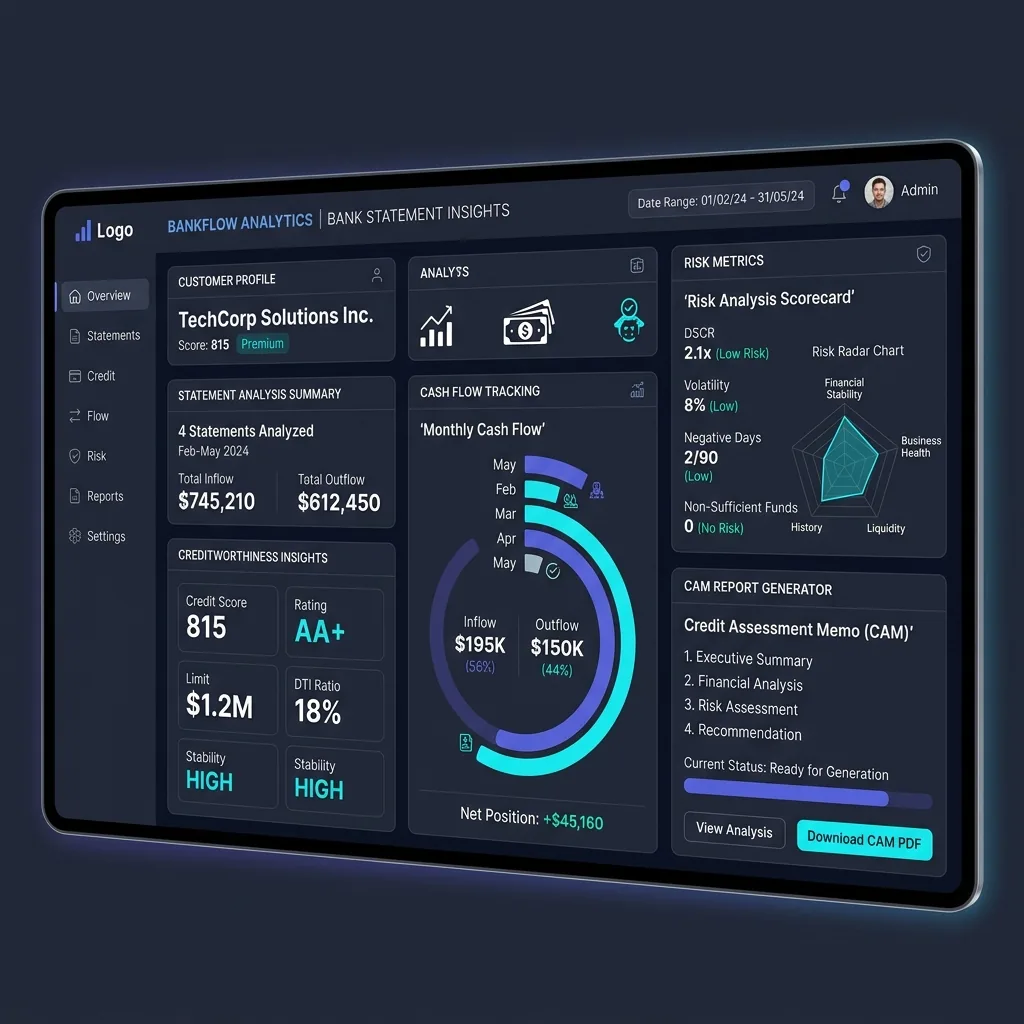
Executive Summary: The best bank statement analyser for Indian institutions is an AI-driven financial intelligence engine capable of parsing diverse statement PDFs across 100+ public, private, and regional banks in seconds. It replaces error-prone spreadsheet entries with forensic fraud screening, automated debt obligation mapping, and standardized computation of CAM in bank statement workflows. This guide breaks down the core evaluation benchmarks, essential features, and software comparison for credit underwriters, NBFCs, and fintech lenders in 2026.
In India’s hyper-competitive digital lending landscape, credit appraisal turnaround time (TAT) and fraud mitigation define whether a lending institution thrives or gets burdened by non-performing assets (NPAs). Whether you are underwriting micro-MSME working capital loans, consumer personal loans, or loan against property (LAP), borrower bank statements remain the single most reliable ground-truth record of actual cash velocity, operational solvency, and financial discipline.
However, manually reviewing multi-month statements across multiple accounts is painfully slow—taking between 45 and 90 minutes per borrower file—and leaves underwriters vulnerable to altered PDF balances, salary spoofing, and round-tripping of funds. Choosing the right bank statement analyser software has become an existential operational decision.
To help credit teams navigate the market, this comprehensive guide evaluates what separates generic document scrapers from the best bank statement analyser solutions built specifically for the Indian financial ecosystem.
Table of Contents
- 1. What Makes the Best Bank Statement Analyser in India?
- 2. 5 Must-Have Capabilities in Modern Bank Statement Analysis Tools
- 3. Automating CAM in Bank Statement Workflows: Why It Matters for Indian Lenders
- 4. Comparison: Manual Parsing vs. Generic OCR vs. Dedicated Analyser Software
- 5. Indian Banking Landscape: Parsing 100+ Banks & Local Compliance
- 6. Critical Fraud & Red Flag Detection Capabilities
- 7. Buyer’s Checklist: How to Choose the Right Tool for Your Workflow
- 8. Why CredTrace Leads as the Industry Standard
- 9. Frequently Asked Questions (FAQ)
- 10. Conclusion & Next Steps
1. What Makes the Best Bank Statement Analyser in India?
Many software tools claim to process bank statements, but most are simply generic PDF table converters wrapped in a web interface. A genuine institutional-grade bank statement analyser in India must accomplish far more than merely dumping numbers into Excel columns.
Indian banking records present unique complexities that break off-the-shelf international software:
- Diverse Statement Formats: India has over 12 public sector banks, 21 private commercial banks, 43 regional rural banks (RRBs), small finance banks, and urban cooperative banks. Each bank uses different narration formats, date conventions (DD/MM/YYYY vs MM/DD/YYYY), credit/debit column splits, and summary placements.
- Password Structures: Statements delivered to borrowers are frequently encrypted with passwords derived from combinations of PAN, Date of Birth, Name, or Customer ID. Top tools decrypt these seamlessly without human intervention.
- Unstructured Transaction Narrations: Indian transactions contain dense strings mixing UPI handles, IMPS reference numbers, NEFT clearing codes, POS merchant IDs, and NACH clearing tags. The software must intelligently parse these narrations into clear financial categories.
- Tampering & Forgery: Easily available PDF editors allow rogue loan applicants or disreputable brokers to alter balances, modify salary deposits, or wipe out cheque bounce penalty entries. Advanced tools must run forensic checks on every page.
The best bank statement analyser delivers high parsing accuracy, forensic fraud screening, and deep financial metric synthesis within seconds of document upload.
2. 5 Must-Have Capabilities in Modern Bank Statement Analysis Tools
When credit evaluation teams and CTOs benchmark modern bank statement analysis tools, five core architectural capabilities determine true operational utility:
Hybrid PDF & OCR Extraction
The engine must parse native vector e-statements directly from digital PDFs while leveraging computer-vision OCR to process scanned passbooks, photocopied printouts, and smartphone photos without tabular misalignment. Read our technical deep dive on how bank statement analysers decode multi-format PDFs.
Ledger Arithmetic Reconciliation
Every transactional line item must be validated mathematically: Previous Balance + Credit − Debit = Running Balance. Any discrepancy indicates forged transaction entries, dropped pages, or spliced rows that manual underwriters routinely miss.
Intelligent Narration Categorization
Using trained Natural Language Processing (NLP) tailored to Indian payment systems (UPI, NEFT, RTGS, IMPS, NACH, e-NACH), the software must automatically separate genuine salary or business sales from loan disbursements, internal transfers, tax payments, and utility expenses.
Automated Debt Obligation Tracking
The software must identify recurring debits indicating existing EMIs, chit fund contributions, or unsecured fintech loan servicing. This enables instant calculation of the applicant's true Fixed Obligation to Income Ratio (FOIR) even when recent borrowings have not yet reflected on bureau credit reports.
Forensic Fraud & Anomaly Alerts
From identifying round-tripping of funds to detecting modified embedded PDF fonts, modern analysis tools provide proactive alerts for underwriters. Learn more about the 7 critical financial red flags detected by automated analysers.
3. Automating CAM in Bank Statement Workflows: Why It Matters for Indian Lenders
In traditional banking and NBFC operations, credit officers spend hours building the Credit Appraisal Memo (CAM) or Credit Assessment Memo. This document serves as the formal underwriting foundation submitted to the credit committee for loan sanctioning.
Deriving a reliable CAM in bank statement workflow has traditionally been the biggest operational bottleneck in retail and MSME lending. Underwriters had to manually copy daily balances, identify inward and outward clearing returns, compute month-on-month revenue trends, and summarize net disposable income into spreadsheet templates.
How Dedicated Software Solves CAM in Bank Statement Preparation
A purpose-built bank statement analyser software automatically synthesizes raw transaction feeds into standardized CAM tables:
- Average Bank Balance (ABB) & Average Monthly Balance (AMB): Evaluates daily ledger liquidity to establish genuine business buffer levels rather than end-of-month window-dressed balances.
- Inward & Outward Return Analysis: Flags cheque and NACH mandate bounces, calculating clearing bounce ratios and penalty charges that reflect credit repayment discipline.
- True Cash Flow Velocity: Separates business receipts from non-operational funds (such as director loans, tax refunds, or asset liquidations) to calculate debt servicing capacity.
- Ready-to-Export CAM Sheets: Generates standardized Excel and PDF CAM summaries that plug directly into existing credit policy frameworks. For a detailed guide on memo structures, read what is a CAM report in banking.
By automating the CAM extraction pipeline, lending teams reduce credit memo preparation time from 2 hours down to under 60 seconds, dramatically accelerating loan turnaround time (TAT).
4. Comparison: Manual Parsing vs. Generic OCR vs. Dedicated Bank Statement Analyser Software
Understanding the fundamental difference between common data processing approaches helps financial institutions select the right technology stack:
| Capability / Feature | Manual Excel Entry | Generic OCR / Document Scrapers | Dedicated Bank Statement Analyser Software |
|---|---|---|---|
| Processing Speed | 45 – 90 mins per statement | 5 – 10 mins (requires clean-up) | 15 – 30 seconds (end-to-end) |
| Multi-Bank Format Handling | High human effort | Frequent table breaks & dropped rows | Automated support for 100+ Indian banks |
| Password Decryption | Manual password entry | Fails on encrypted PDFs | Automated pattern matching & decryption |
| Balance Reconciliation | Manual cross-checking | None (text capture only) | Line-by-line mathematical verification |
| Forensic Tamper Detection | Nearly impossible for humans | None | Font, pixel & metadata audit trails |
| Circular Transaction Mapping | Cannot trace multi-party loops | None | Automated counterparty network graph |
| CAM in Bank Statement Generation | Manual template drafting | Requires extensive manual modeling | One-click export of verified CAM reports |
| Operational Cost & Scalability | High staffing overhead; bottlenecks | Moderate; high developer maintenance | Low per-file cost; scales to thousands daily |
5. Indian Banking Landscape: Parsing 100+ Banks & Local Compliance
Deploying bank statement analysis tools in India requires strict adherence to local banking nuances and national data protection standards:
1. Support for All Banking Tiers: In tier-2, tier-3, and rural lending, applicants rarely submit statements from top private banks alone. Lenders must parse statements from State Bank of India (SBI), Bank of Baroda, Punjab National Bank, Canara Bank, and regional cooperative entities. The bank statement analyser for loan underwriting must handle both digital e-statements and physical passbook photos.
2. Account Aggregator (AA) Synergy: While the Account Aggregator framework provides digital consent pulls, coverage is not universal, customer consent drop-offs remain significant, and historical statements often require manual fallback. Leading lenders deploy a hybrid model combining AA with PDF statement parsing. Learn more in our comparison of Account Aggregator vs bank statement analyser.
3. Regulatory & Data Privacy Mandates: Software handling Indian borrower data must comply fully with the Digital Personal Data Protection (DPDP) Act 2023 and Reserve Bank of India (RBI) digital lending guidelines. Critical requirements include data localization on Indian soil, end-to-end encryption in transit (TLS 1.3) and at rest (AES-256), and zero data retention policies.
6. Critical Fraud & Red Flag Detection Capabilities
The true test of any bank statement analyser software is its ability to protect the lender's balance sheet from sophisticated fraud. In 2026, fraudsters utilize desktop publishing software and online PDF tools to manipulate financial figures.
PDF Metadata & Font Forensics
Detects anomalies such as non-standard embedded fonts, Adobe Acrobat or Canva modification timestamps, and altered text bounding boxes. Read our dedicated guide on PDF bank statement tamper detection.
Circular Transactions & Round-Tripping
Identifies fund loops where an applicant moves money between related accounts to artificially inflate turnover figures prior to applying for credit. Explore how to detect circular transactions in bank statements.
GST & Sales Cross-Verification
Cross-references monthly bank credits against GSTR-3B filings to verify legitimate business revenue and flag tax or cash inflation. Learn how GST and bank statement reconciliation works for MSME loans.
Salary Spoofing & Cash Inflow Flags
Verifies recurring monthly salary deposits against payroll narration consistency and flags suspicious round-sum cash deposits immediately before loan application dates.
7. Buyer’s Checklist: How to Choose the Right Tool for Your Workflow
Before onboarding a vendor or signing an enterprise contract, use this evaluation checklist to assess prospective bank statement analysis tools:
8. Why CredTrace Leads as the Industry Standard
Built specifically for the Indian credit and underwriting ecosystem, CredTrace delivers an institutional-grade platform designed to maximize underwriting throughput while minimizing credit risk:
- Universal Bank Coverage: Instant parsing across 100+ Indian public sector, private commercial, regional rural, and cooperative bank formats.
- Sub-30-Second Processing: Fully automated multi-month statement parsing, narration categorization, and balance reconciliation.
- Automated CAM Generation: Instantly prepares comprehensive Credit Assessment Memos with verified ABB, AMB, FOIR, and bounce ratios.
- Advanced Anti-Fraud Engine: Multi-layer forensic analysis detecting PDF metadata modifications, pixel irregularities, and counterparty circular loops.
- Enterprise-Grade Security: Built with zero-retention memory processing, end-to-end encryption, and full compliance with the DPDP Act 2023.
9. Frequently Asked Questions (FAQ)
What is the best bank statement analyser software in India for lenders?
The best bank statement analyser software in India combines 100+ Indian bank PDF format recognition (including scanned, password-protected, and cooperative bank formats), forensic fraud detection (pixel edits, metadata tampering, circular transaction loops), real-time cash flow metrics (ABB, FOIR, bounce ratios), and instant Credit Assessment Memo (CAM) export. CredTrace is engineered specifically for Indian NBFCs, banks, and fintech lenders seeking automated underwriting with sub-30-second processing and DPDP Act compliance.
How does automated software generate CAM in bank statement workflows?
In digital underwriting, software automating CAM in bank statement pipelines extracts raw line items, reconciles opening and closing balances, categorizes inflows and outflows, calculates Average Bank Balance (ABB) and debt service obligations, flags cheque/NACH returns, and automatically formats these figures into standardized Credit Appraisal Memo sheets (Excel and PDF) ready for credit committee review.
What key features distinguish enterprise bank statement analysis tools from free converters?
Unlike free PDF-to-Excel converters that only extract raw text without financial comprehension, enterprise bank statement analysis tools perform NLP-based transaction enrichment, detect circular trading and shell entity deposits, calculate banking behavioral scores, verify GST turnover congruence, and guarantee bank-grade data security with zero unencrypted document retention.
Can bank statement analyser software handle password-protected and scanned Indian bank PDFs?
Yes. Top-tier bank statement analysers in India incorporate automated password decryption based on applicant standard identifiers (such as PAN, DOB, customer ID) and deploy advanced financial OCR engines capable of extracting transaction tables from low-resolution scans, distorted mobile camera uploads, and multi-column passbook copies.
Is bank statement analyser software compliant with RBI digital lending guidelines and the DPDP Act 2023?
Enterprise bank statement analysis tools designed for the Indian ecosystem adhere strictly to RBI digital lending mandates and India's Digital Personal Data Protection (DPDP) Act 2023. They feature localized data hosting on Indian servers, end-to-end AES-256 encryption, role-based access control (RBAC), and configurable automated document retention and purge schedules.
10. Conclusion & Next Steps
Evaluating and choosing the best bank statement analyser is no longer just an IT or operational decision—it directly determines your credit risk posture, portfolio NPA rates, and customer acquisition efficiency. Lenders that automate statement parsing and CAM generation achieve turnaround times in minutes rather than days, winning creditworthy borrowers while preventing sophisticated document fraud.
Discover how CredTrace transforms raw statements into actionable cash flow intelligence. Explore our bank statement analyser platform or review our guide on how automated bank statement analysis is revolutionizing lending today.