In today’s competitive lending market, borrower expectations and credit risk parameters have reached a pivotal crossroads. Retail borrowers seeking personal or home financing expect instant in-principle loan approvals, while Micro, Small, and Medium Enterprises (MSMEs) require fast access to working capital to meet inventory cycles and payroll. Non-Banking Financial Companies (NBFCs), digital fintech lenders, and commercial banks that take three to five business days to deliver a credit decision are losing high-quality borrowers to agile competitors.
Yet, accelerated loan turnaround times (TAT) must not come at the cost of underwriting diligence. Credit defaults, non-performing assets (NPAs), and loan fraud represent existential threats to any lending institution's balance sheet. While traditional credit bureau scores provide a historical snapshot of past repayment discipline, they frequently fail to reflect real-time operational solvency, especially for New-to-Credit (NTC) individuals and cash-flow-driven MSMEs.
The true source of borrower financial truth resides in their bank statements. However, reviewing hundreds of pages of messy PDF statements across dozens of diverse banking layouts is an operational nightmare. This is where an AI-powered bank statement analyser transforms credit operations. In this definitive guide, we explore how automated bank statement analysis works, the 8 mission-critical financial ratios calculated, how to catch sophisticated document fraud, and how modern lenders use CredTrace's automated bank statement analyser to cut underwriting TAT from days to under 30 seconds.
1. The Underwriting Bottleneck: Why Manual Statement Audits Fail
For decades, credit appraisal teams relied on manual review: printing out PDF statements, highlighting salary credits with physical markers, entering debit lines into massive Excel spreadsheets, and manually computing Average Bank Balances (ABB).
In modern lending environments processing thousands of applications per month, this manual paradigm creates four critical operational vulnerabilities:
- 1. Severe Turnaround Delays: Manually auditing 6 to 12 months of statements across multiple bank accounts requires 45 to 90 minutes per borrower. When underwriters encounter 100+ page statements with thousands of micro-UPI transactions, backlogs quickly balloon.
- 2. Human Auditing Fatigue & Computational Errors: Underwriters reviewing statements under tight production quotas miss subtle auto-debit lines, unrecorded NBFC micro-loans, or recurrent cheque bounce penalties, skewing debt-to-income calculations.
- 3. Inability to Spot Digital Forgery: With modern web-based PDF editors, dishonest borrowers can alter opening balances, falsify payroll entries, or delete EMI deductions. Human visual audits cannot detect font mismatch anomalies or pixel alterations without specialized forensic software.
- 4. Unstandardized Credit Assessment Memos (CAM): Different underwriters formulate CAM sheets with varying degrees of granularity. Without automated standardization, risk committees face inconsistent decision quality across regional branch networks.
2. How an AI Bank Statement Analyser Works: The 5-Stage Architecture
A modern bank statement analyser is not merely an Optical Character Recognition (OCR) reader. It is an end-to-end financial intelligence engine that converts messy, unstructured banking documents into institutional-grade credit reports. Here is how the processing pipeline functions:
Stage 1: Secure Ingestion & Password Decryption
Borrowers download password-protected e-statements from NetBanking portals. Top Indian banks utilize distinct password formulas (e.g., PAN + Date of Birth, or Customer ID). An enterprise bank statement analyser handles decryption securely in-memory during upload, validating credentials without ever storing sensitive passphrases on unencrypted disk storage.
Stage 2: Vision-Based Parsing & Table Boundary Detection
Indian banking exhibits no uniform statement structure. HDFC Bank, ICICI Bank, State Bank of India (SBI), and Axis Bank employ drastically different column headers, date formats, running balance alignments, and multi-page pagination splits. Rather than fragile static coordinate templates, modern analysers deploy deep learning Computer Vision models that visually map transaction grids, merge split rows, and parse data regardless of layout shifts.
Stage 3: NLP Narration Cleaning & Entity Resolution
Raw statement narrations in India are cluttered with payment gateway codes, IMPS reference IDs, and cryptic UPI strings:
UPI/628192019481/CR/razorpay@icici/ApexTechEnterprises/INVOICE-8491
Natural Language Processing (NLP) models strip out protocol noise, isolate the true counterparty (ApexTechEnterprises), and classify the transaction into structured taxonomy categories: operational revenue, payroll, vendor payment, statutory tax deduction, or loan repayment.
Stage 4: Mathematical Ledger Verification & Tamper Detection
As rows are extracted, the engine runs continuous algebraic validation:
Opening Balance + Total Credits − Total Debits = Closing Running Balance
Simultaneously, forensic algorithms inspect embedded PDF fonts, creation software tags, and vector layer alterations to ensure the statement has not been modified using desktop tools. For a detailed breakdown of document verification, review our guide on PDF bank statement tamper detection.
Stage 5: Credit Metric Computation & Instant CAM Generation
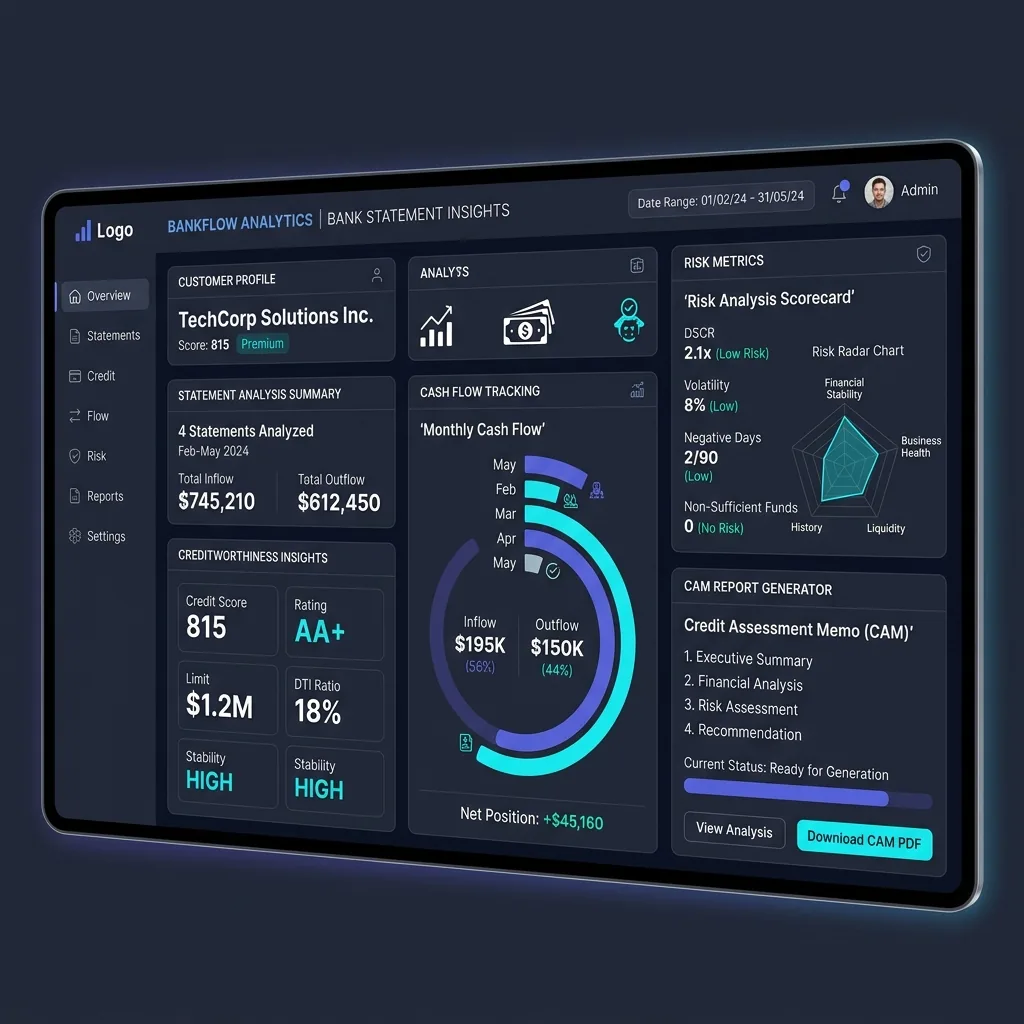
The platform synthesizes thousands of transactions into clean financial metrics, generates cash flow graphs, computes credit scores, and exports an automated Credit Assessment Memo (CAM) ready for credit committee sanctioning.
3. 8 Essential Financial Ratios Calculated by a Bank Statement Analyser
When credit underwriters review bank statements, they need actionable ratios that reflect cash flow vitality, repayment resilience, and debt obligations. A dedicated bank statement analyser calculates these metrics instantly across 3, 6, 12, or 24-month time horizons:
1. Average Bank Balance (ABB) & Average Monthly Balance (AMB)
While closing balances can be artificially inflated on the last day of the month, the Average Bank Balance (ABB) calculates the average daily end-of-day balance across the entire month. The analyser flags discrepancies where day-to-day liquidity is near zero despite a high month-end balance.
2. Fixed Obligation to Income Ratio (FOIR) & Unrecorded EMIs
FOIR measures what proportion of a borrower’s net monthly earnings is already committed to servicing debt. An AI analyser tracks recurring NACH debits, standing instructions, and repayments to obscure fintech apps that do not yet report to traditional credit bureaus, preventing over-leveraged lending.
3. Inward & Outward Bounce Ratios
The analyser differentiates between outward cheque/NACH bounces (charges incurred due to insufficient funds in the borrower’s account—an acute sign of financial distress) and inward bounces (cheques deposited by customers that bounced—indicating counterparty default risk in MSME trade).
4. Net Operating Cash Flow & Cash Inflow Velocity
By separating genuine customer receivables from non-operating inflows (promoter capital injections, inter-account transfers, or asset sales), the system calculates true operating cash burn and determines whether normal operations generate enough free cash to service proposed debt.
5. Salary Credit Regularity & Employer Authenticity
For salaried underwriting, the analyser checks for consistent credit dates, recurring payroll tags (e.g., NEFT/RTGS salary narrations), and employer entity validation. It identifies fraudulent salary spoofing where personal UPI transfers are disguised as company payroll.
6. Cash Withdrawal Proportions (Siphoning Risk)
High ratios of cash ATM withdrawals or immediate bearer cheque debits following large customer receipts can signal fund diversion, unrecorded grey-market transactions, or loan siphoning in commercial accounts.
7. Circular Transactions & Counterparty Loops
Borrowers frequently attempt to inflate declared banking turnover by circulating funds between related shell companies or personal sister accounts. An intelligent analyser detects circular transaction loops and deducts artificial volume from eligible turnover. Learn how this works in our analysis of circular transaction detection.
8. Balance Volatility & EOM Window Dressing
A borrower may borrow short-term funds from unorganized money lenders on the 29th of the month and repay them on the 2nd of the following month simply to show an inflated closing balance. An automated analyser calculates a Liquidity Volatility Index that uncovers this window dressing.
4. Comparison: Manual Review vs. Basic Parsers vs. CredTrace AI Analyser
Not all statement tools offer equal underwriting depth. Understanding the architectural differences helps lending institutions select the right infrastructure:
| Evaluation Feature | Manual Excel Audit | Basic PDF OCR Parser | CredTrace AI Analyser |
|---|---|---|---|
| Processing TAT per File | 45 – 90 minutes | 2 – 5 minutes | Under 15 seconds |
| Multi-Bank Format Support | Limited to human skill | Requires rigid templates | 100+ Banks via Vision AI |
| Tamper & Forgery Detection | Zero capability | None | Deep vector & font audit |
| Hidden EMI & NACH Detection | Easily overlooked | Raw text dump only | Automated loan clustering |
| Circular Loop Detection | Impossible at scale | Not supported | Counterparty loop mapping |
| Ready-to-Use CAM Sheet | Manual compilation | Raw CSV only | Instant PDF/Excel CAM |
5. MSME vs. Retail Underwriting: How the Analyser Adapts
Different loan products demand distinct risk evaluation lenses. An enterprise-grade analyser adjusts its scoring models dynamically based on the loan category:
Retail & Personal Loan Underwriting
In unsecured retail lending, underwriters care most about salary stability, disposable surplus, and lifestyle expenditure:
- Salary Credit Authenticity: Validating that payroll credits originate from registered corporate accounts rather than round-trip family transfers.
- Discretionary vs. Non-Discretionary Spend: Categorizing utility, grocery, e-commerce, and dining outflows to evaluate disposable cash buffers.
- Buy-Now-Pay-Later (BNPL) Burden: Identifying micro-debits to fintech lending entities that consume small parts of monthly income but signal over-indebtedness.
MSME & Business Working Capital Underwriting
Commercial underwriting shifts focus to operational health, turnover legitimacy, and working capital cycles:
- Customer Concentration Risk: Analyzing whether 80% of business revenues stem from a single client, leaving the enterprise vulnerable to contract cancellation.
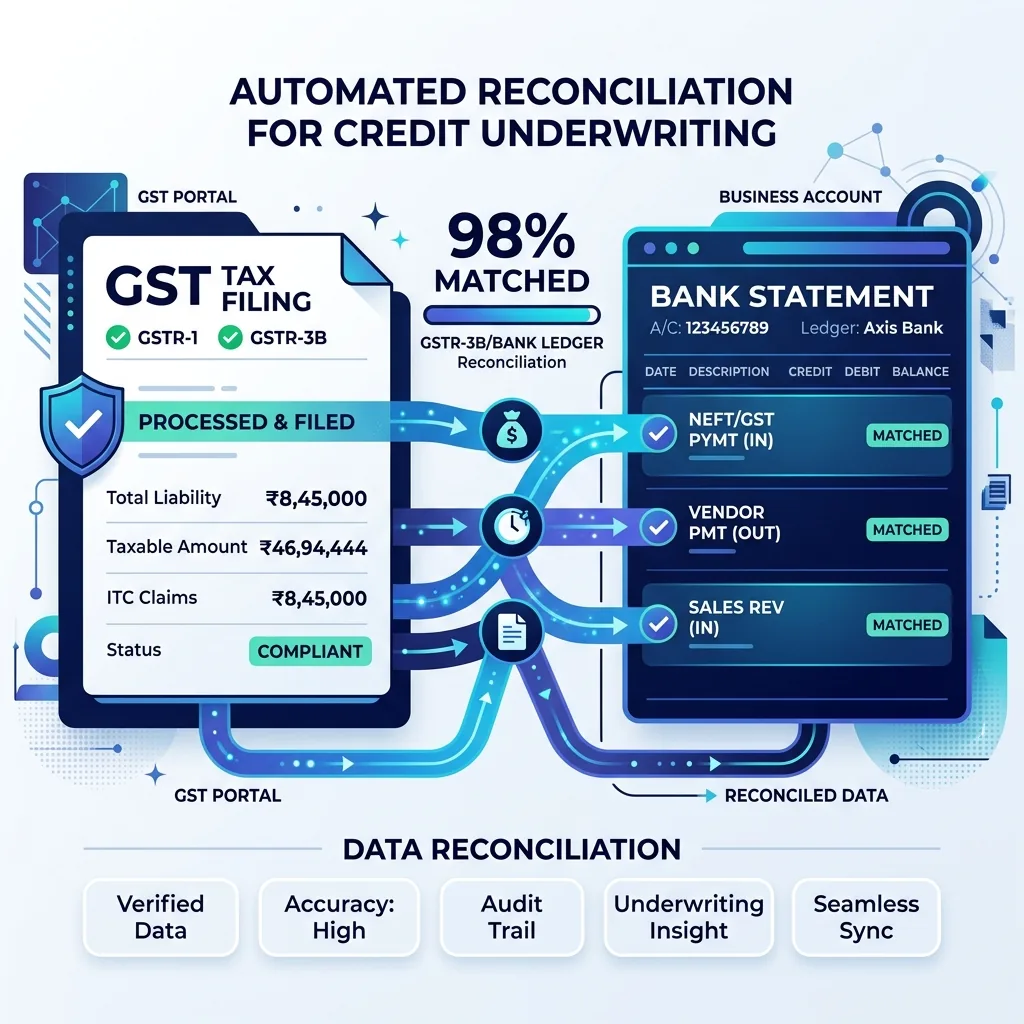
- GST vs. Banking Turnover Cross-Check: Reconciling actual bank credits against filed GSTR-3B/1 returns to spot undeclared cash sales or inflated turnover. Explore our dedicated guide on GST and bank statement reconciliation.
- Working Capital Utilization: Tracking OD/CC account drawdowns, penal interest debits, and interest servicing frequency to assess operational stress.
6. Regulatory Compliance and RBI Digital Lending Guidelines
Under the Reserve Bank of India’s (RBI) Master Directions on Digital Lending, financial institutions bear strict legal accountability for customer data privacy, storage limitations, and third-party vendor oversight. Lenders cannot afford to use unverified online tools or overseas parsing utilities that store borrower statements indiscriminately.
CredTrace is architected with an enterprise security-first approach:
- Zero Persistent Storage: Customer bank statement PDFs are parsed in volatile memory and can be automatically purged immediately after extraction, adhering to data minimization mandates.
- End-to-End Encryption: All data in transit and at rest is secured via TLS 1.3 and AES-256 encryption.
- Audit Trails & Role-Based Access: Every extracted data point, fraud check, and CAM generation step produces immutable audit logs, giving compliance officers complete visibility during RBI regulatory reviews.
Frequently Asked Questions (FAQs)
What is an automated bank statement analyser for loan underwriting?
An automated bank statement analyser is an AI-powered financial intelligence platform that extracts transaction data from bank PDF statements, normalizes multi-bank layouts, calculates critical solvency metrics (such as ABB, AMB, FOIR, and bounce ratios), detects financial fraud or tampering, and generates structured Credit Assessment Memos (CAM) in seconds.
How does a bank statement analyser calculate Fixed Obligation to Income Ratio (FOIR)?
The analyser parses transaction descriptions using natural language processing to identify recurring NACH debits, loan EMI payments, and credit card settlements across all declared and undeclared bank accounts. It divides total monthly debt repayments by verified recurring monthly net income to compute an exact, real-time FOIR percentage.
Can an automated bank statement analyser detect tampered or forged PDF statements?
Yes. Advanced analysers like CredTrace examine PDF document metadata, vector layout coordinates, embedded font kerning discrepancies, and pixel-level modifications. It also validates mathematical ledger balance integrity (Previous Balance + Credits - Debits = Running Balance) across every transaction line item to catch edited numbers.
Why is bank statement analysis preferred over credit bureau scores alone?
Credit bureau scores are backward-looking indicators reflecting historical credit behavior from 30 to 90 days ago. Bank statement analysis provides real-time visibility into active operational liquidity, daily cash burn, unrecorded borrowing, bounce occurrences, and revenue trends, which is especially vital for New-to-Credit (NTC) and MSME borrowers.
How many Indian banks does CredTrace support?
CredTrace supports statement parsing and transaction categorization across 100+ Indian commercial, public sector (PSU), private, regional rural (RRB), and cooperative banks, effortlessly processing multi-column formats, e-statements, and scanned PDF documents.
Summary & The Future of Credit Decisioning
As digital lending moves toward automated, algorithmic underwriting, reliance on manual spreadsheets is no longer sustainable. Deploying a specialized AI bank statement analyser allows Indian lenders, NBFCs, and fintech companies to accelerate loan turnaround times, slash customer drop-offs, uncover hidden debt obligations, and protect their loan portfolios from sophisticated fraud.
Ready to experience automated statement extraction and instant CAM report generation? Start your exploration with CredTrace Bank Statement Analyser today.