In India's rapidly evolving digital lending ecosystem, speed and risk mitigation are the primary indicators of operational success. Non-Banking Financial Companies (NBFCs), fintech startups, and legacy commercial banks process thousands of loan applications daily. Whether evaluating a small business owner for an unsecured MSME loan or assessing a salaried employee for a personal line of credit, the borrower’s bank statement remains the single source of truth for real-time cash flow verification.
However, extracting financial intelligence from raw documents is an operational bottleneck. Bank statements are almost always uploaded as PDF files, which represent a complex visual grid rather than structured data. Because India has dozens of major financial institutions—ranging from public sector units (PSUs) like State Bank of India (SBI) to private giants like HDFC, ICICI, and Axis, along with rural and cooperative banks—there is no standardized statement layout.
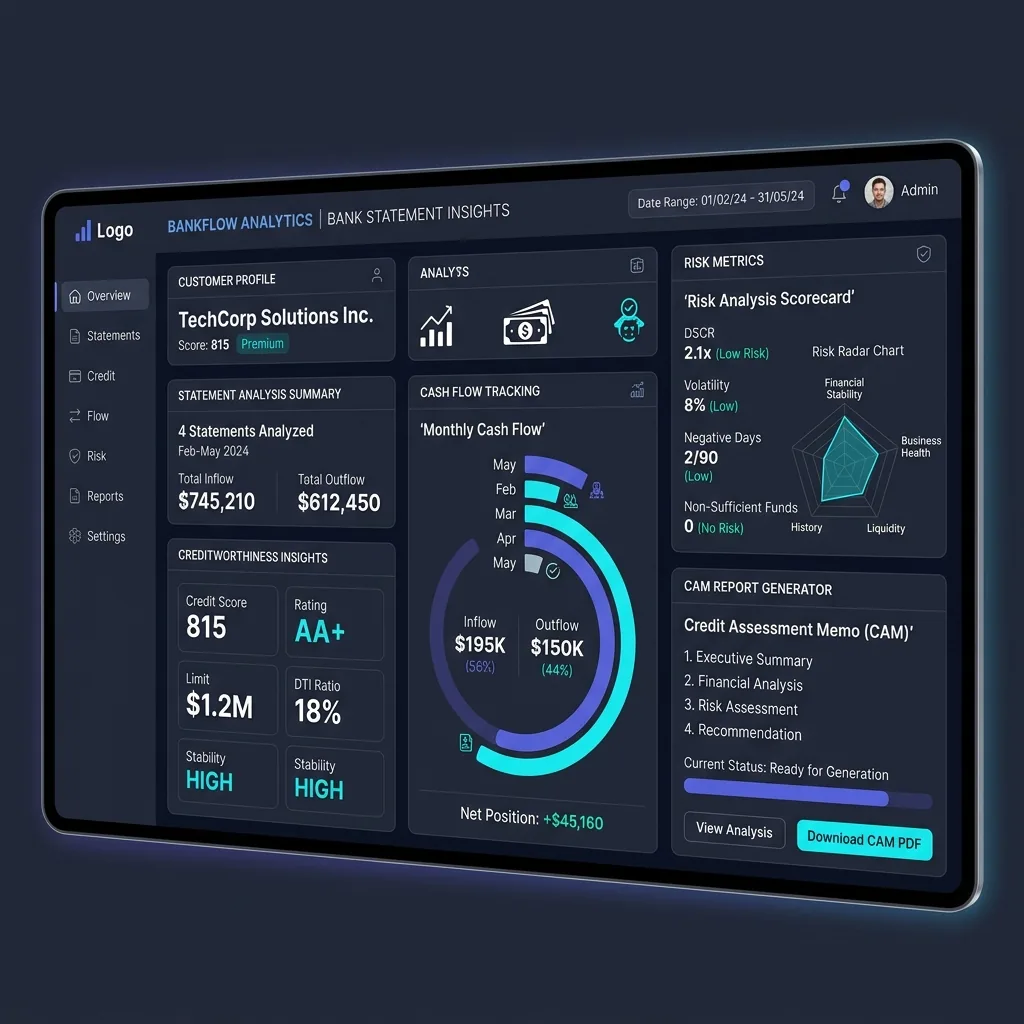
This is where an AI-powered bank statement analyser becomes indispensable. Rather than relying on credit underwriters to manually open, read, and type out data from hundreds of pages of PDF statements, modern risk management teams deploy automated engines. These systems handle password protection, reconcile format discrepancies, and clean messy transaction narrations, converting raw documents into credit-ready insights in seconds.
1. The Password Decryption Challenge in Indian Banking
For security and data privacy, almost all Indian banks password-protect the PDF bank statements they email to customers. When borrowers download these statements and upload them to a lender's origination portal, they are encrypted.
The primary operational challenge is that these passwords are not uniform. Each bank utilizes its own custom formula to construct the decryption key:
- HDFC Bank: Typically uses the customer's Customer ID (Cust ID) or a combination of the name and date of birth.
- ICICI Bank: Often relies on a combination of the account holder's name, day and month of birth, or the registered mobile number.
- State Bank of India (SBI): Employs a complex structure combining the registered mobile number and the date of birth in specific formats (e.g., DDMMYYYY).
- Axis Bank: Frequently utilizes the account holder's registered email address or customer ID.
In a manual underwriting setup, this encryption creates immediate customer drop-offs and operational friction. Underwriters must contact the borrower to ask for the password, wait for a response, and manually type it in to open the file.
An automated bank statement analysis platform resolves this programmatic bottleneck. Advanced platforms implement decryption protocols that accept borrower passwords during the upload phase, validate them in real-time, and decrypt the files in memory without storing sensitive passphrases. By keeping decryption completely secure and integrated, the system prevents drop-offs and keeps the origination pipeline moving smoothly.
2. The Multi-Format Layout Maze: Private vs. PSU Banks
Once a PDF is decrypted, the next hurdle is parsing the transaction table. In India, there are no layout regulations for bank statements. An HDFC statement looks completely different from a Bank of Baroda statement, which in turn looks nothing like an SBI statement.
These format variations show up in several ways:
Column Layouts and Orders
Some banks place the transaction date, value date, description, withdrawals, deposits, and running balance in that exact order. Others put deposits before withdrawals or combine debit and credit columns into a single "Amount" column, using "Cr" and "Dr" flags to indicate the cash flow direction. A simple parser that assumes the third column is always "Withdrawal" will fail when processing statements from banks with different column ordering.
Date Format Variations
Date formatting is highly inconsistent. You will find `DD/MM/YYYY`, `DD-MMM-YYYY`, `MM/DD/YY`, or even dates split across multiple lines where the year is placed directly below the day and month. If the parsing software cannot read these variations, it will fail to sequence transactions, resulting in incorrect calculations of Average Monthly Balances (AMB) and transaction timelines.
Page Breaks and Merged Cells
Multi-page bank statements contain header grids on every page. Transaction narratives that span multiple lines often break across pages, causing text lines to merge with the headers of the subsequent page. Traditional layout parsers frequently misalign these split entries, leading to missing transaction values or corrupted ledger balances.
To overcome this, legacy parsing tools relied on layout templates. Lenders had to build and maintain separate templates for every bank in India. However, this model is fragile. When HDFC or SBI updates their PDF layout—which happens regularly without warning—the template breaks, credit operations stall, and underwriters must reversion to manual analysis.
Modern AI-driven bank statement analysis software bypasses template reliance by using advanced Computer Vision (CV) and Deep Learning models. These models analyze the visual structure of the document to locate the transaction table, identify column headers, merge split rows, and parse data accurately regardless of layout changes.
3. Resolving OCR Noise in Scanned and Low-Quality Documents
While e-statements downloaded directly from online portals are digital PDFs with clean, copyable text layers, borrowers often upload scanned copies of physical statement printouts or photograph statement pages using their smartphones.
Scanned documents introduce optical noise, including skewed angles, folds, handwritten notes by branch officials, rubber stamps, and low-contrast text. Standard Optical Character Recognition (OCR) engines like Tesseract frequently misread critical numbers, converting a `0` to an `8` or a `3` to an `8`. In credit decisioning, an OCR error that misreads a credit of ₹80,000 as ₹30,000 can lead to an incorrect loan rejection.
An intelligent bank statement analyser combines OCR with mathematical validation checks. As the engine extracts transaction rows, it performs a continuous mathematical audit:
Previous Balance + Credit Amount - Debit Amount = Current Running Balance
If the calculated balance does not match the printed running balance, the system runs error-correction algorithms to identify the misread character. This ensures that the parsed data is mathematically consistent, preserving data integrity for the underwriting report.
4. Cleaning and Categorizing Indian Transaction Narrations
Once the transaction data is extracted, the bank statement analyser must interpret the transaction narrations. In India, the surge in digital payments via Unified Payments Interface (UPI) has changed bank statements. A typical statement now contains hundreds of micro-transactions, resulting in cluttered narration strings.
A typical UPI narration look like this:
UPI/621516171822/P2A/9876543210@ybl/Sharma Traders/REF-482910
To evaluate credit risk, an analyser must parse this text, strip out the transaction metadata (UPI reference numbers, payment gateways), and identify the counterparty ("Sharma Traders").
Categorizing these transactions accurately allows lenders to calculate key credit metrics:
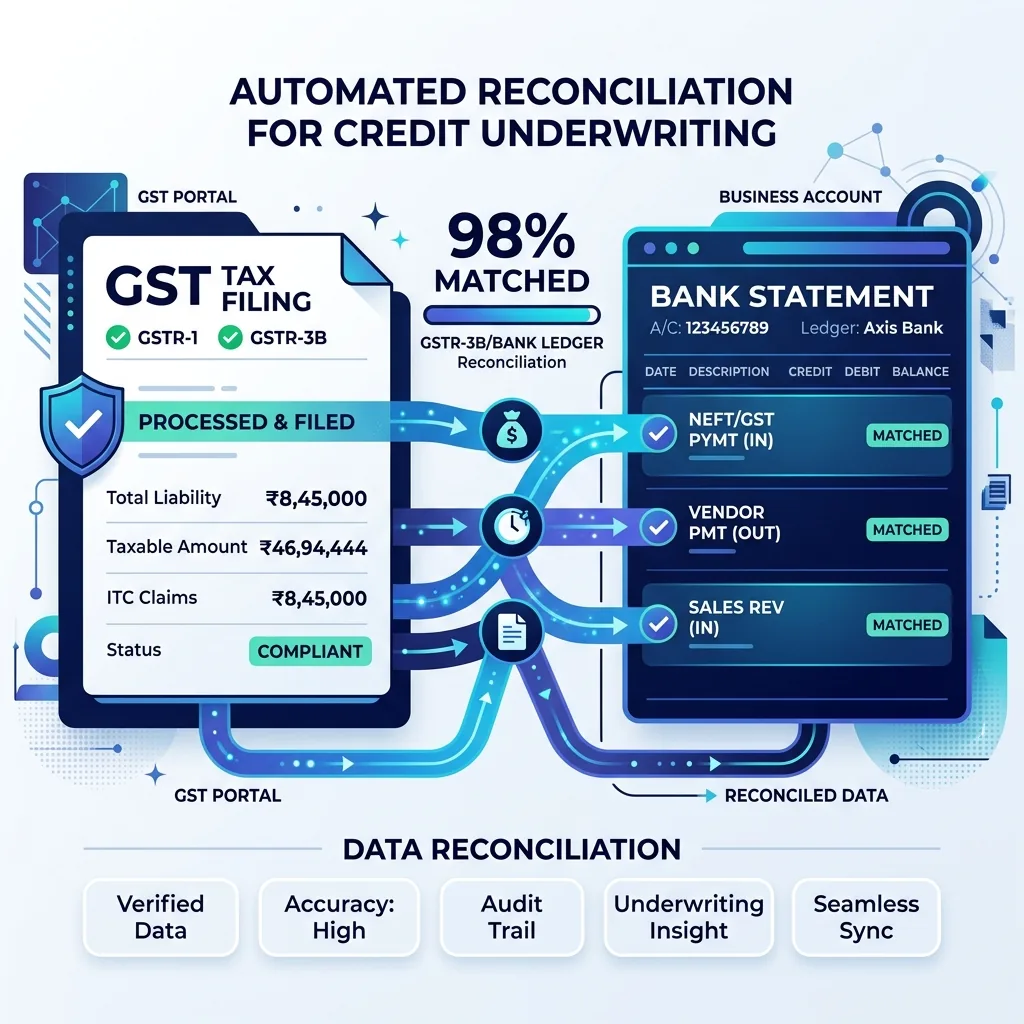
- Identifying Revenue Credits: The analyser distinguishes genuine business sales credits from non-operational cash inflows, such as personal transfers, promoter equity, or short-term loan disbursements. This step is critical for aligning bank data with tax filings during GST and bank statement reconciliation.
- Calculating Debt Obligations: The system identifies recurring NACH, E-Mandate, or UPI auto-debits to map active loans, calculating the borrower's actual Fixed Obligation to Income Ratio (FOIR).
- Spotting Financial Red Flags: It checks for bounced cheques, failed NACH mandates, and transaction loops that indicate circular trading or balance inflation, highlighting these financial red flags for the underwriting team.
The Competitive Advantage for Indian Lenders
Using an automated bank statement analyser like CredTrace transforms the credit underwriting workflow from a slow, manual chore into a fast, digital process. By processing multi-format bank statement PDFs in under 15 seconds, lenders can lower turnaround times (TAT), prevent borrower drop-offs, and reduce default rates by identifying transactional fraud early.
If you are looking to scale your retail or MSME loan portfolio while maintaining high underwriting standards, integrate a dedicated automated bank statement analyser into your credit workflow today.