Quick Definition: A bank statement analyser (also spelled bank statement analyzer) is an AI-powered financial intelligence platform that automatically ingests unstructured PDF bank statements, extracts line-by-line transaction data, standardizes messy narrations, detects fraudulent tampering or circular transactions, and generates ready-to-use Credit Assessment Memos (CAM) within seconds.
In today's digital credit ecosystem, financial institutions, Non-Banking Financial Companies (NBFCs), fintech startups, and chartered accountants face an ever-growing influx of financial records. Whether underwriting a micro-business loan, approving a retail personal loan, or conducting statutory forensic audits, the applicant’s bank statement represents the ultimate single source of truth for actual cash flow liquidity and repayment discipline.
However, relying on manual human audits—where underwriters spend 45 to 90 minutes per application manually typing transaction figures into spreadsheets—creates massive operational bottlenecks, inflates loan origination costs, and leaves lenders blind to sophisticated digital forgery. Deploying an automated bank statement analyser has shifted from a competitive advantage to a foundational requirement for any institution serious about risk management and speed.
Table of Contents
- 1. What is a Bank Statement Analyser?
- 2. How an Automated Bank Statement Analyser Works: The 6-Stage Pipeline
- 3. Core Financial Metrics Calculated by a Statement Analyser
- 4. Manual Excel Analysis vs. AI Bank Statement Analyser
- 5. Critical Fraud Detection Capabilities Every Analyser Must Have
- 6. Who Uses a Bank Statement Analyser? Key Industry Applications
- 7. How to Choose the Best Bank Statement Analyser in India
- 8. Why CredTrace is the Industry-Standard Bank Statement Analyser
- 9. Frequently Asked Questions (FAQs)
- 10. Conclusion & Next Steps
1. What is a Bank Statement Analyser?
A bank statement analyser is a specialized financial data processing tool that bridges the gap between static, unstructured PDF documents and actionable credit decisioning. When a borrower downloads an e-statement from net banking or scans a physical statement, that document exists as a visual layout of text coordinates, lines, and tables. Traditional software cannot read these tables reliably without custom scripts.
An intelligent bank statement analyser uses advanced Computer Vision, Optical Character Recognition (OCR), and Natural Language Processing (NLP) models to ingest statements from hundreds of different banking institutions. It extracts transaction dates, reference IDs, debit/credit values, running balances, and narrations—standardizing them into clean, structured data models that feed directly into Loan Origination Systems (LOS) or underwriting workflows.
2. How an Automated Bank Statement Analyser Works: The 6-Stage Pipeline
To understand the sophistication of modern financial statement parsing, let's explore how an enterprise-grade platform like CredTrace transforms a raw, password-encrypted PDF into a complete credit profile in less than 30 seconds:
Secure Ingestion & Decryption
Over 95% of e-statements issued by Indian banks (HDFC, SBI, ICICI, Axis) are encrypted with customer-specific passwords (e.g., DOB + Mobile, Customer ID, or PAN). A modern analyser incorporates dynamic decryption pipelines that securely decrypt files in-memory without persistent storage of sensitive credentials.
Document OCR & Multi-Format Parsing
Unlike rigid template parsers that break whenever a bank updates its PDF layout, vision-based AI models detect table headers, boundary lines, and multi-line narrations. The engine correctly differentiates between "Cr/Dr" single-column formats and dedicated debit/credit column layouts across 100+ banks.
Intelligent NLP Categorisation
Raw transaction descriptions (e.g., CMS/NACH/BAJFIN/001923/LOAN) are parsed and classified into 30+ standardized financial categories, including Salary, Utility, Vendor Payments, EMI, Tax Remittances, Dividend Inflows, ATM Cash, and UPI Transfers.
Ledger Balance Cross-Reconciliation
The analyser checks mathematical ledger continuity for every single row item: Opening Balance + Credits - Debits = Closing Balance. Any arithmetic discrepancy immediately flags potential document tampering or missing page scans.
Forensic Anomaly & Fraud Detection
The file undergoes deep forensic inspection, scanning for altered PDF fonts, PDF editing software metadata, backdated transaction insertions, and multi-account circular transactions (fund round-tripping). Learn more in our guide on PDF bank statement tamper detection.
Automated CAM Generation & Scoring
All synthesized cash flow indicators, ratios, and risk flags are compiled into a comprehensive Credit Assessment Memo (CAM) available via instant API webhook response, formatted Excel sheet, or executive PDF summary.
3. Core Financial Metrics Calculated by a Statement Analyser
When evaluating loan applicants, credit underwriting teams need rigorous, multi-dimensional indicators rather than generic averages. An automated bank statement analyser computes these mission-critical metrics automatically:
1. Average Bank Balance (ABB) & Average Monthly Balance (AMB)
Month-end balances are easily manipulated through temporary borrowings. ABB calculates the true average of day-to-day closing balances across the entire statement cycle, revealing genuine working capital liquidity.
2. Fixed Obligation to Income Ratio (FOIR)
The analyser clusters all recurring debt outflows (NACH mandates, ECS debits, and standing instructions) across all banks, comparing total monthly debt payments against verified recurring earnings to compute an exact FOIR percentage.
3. Inward & Outward Bounce Analysis
Differentiates between outward bounces (insufficient fund charges incurred by the borrower—a severe indicator of credit distress) and inward bounces (bounced customer cheques, reflecting client payment unreliability in MSME businesses).
4. Operating Cash Inflow Velocity
Separates core operational business revenue from non-operating credits such as promoter capital injections, loan disbursements, inter-account transfers, or tax refunds, establishing sustainable debt service capability.
5. Cash Dependency & Siphoning Ratio
Calculates the proportion of funds withdrawn as physical cash immediately following large customer credits, alerting credit managers to potential turnover diversion, grey-market activities, or fund siphoning.
6. Counterparty & Circular Trade Mapping
Detects artificial transaction loops where funds circulate repeatedly between related sister companies or family accounts to inflate business turnover figures. Learn how to detect circular transactions automatically.
4. Manual Excel Analysis vs. AI Bank Statement Analyser
Lenders transitioning from manual document review to automated financial statement software experience dramatic improvements in speed, risk mitigation, and cost efficiency. The comparison table below highlights the operational advantages:
| Operational Parameter | Manual Excel Review | Basic OCR Scraping Tools | Modern AI Bank Statement Analyser |
|---|---|---|---|
| Turnaround Time (TAT) | 45 – 90 mins per file | 3 – 8 mins per file | Under 15 – 30 seconds |
| Multi-Bank Coverage | Dependent on analyst skill | Fragile; breaks with layout updates | 100+ Indian Banks (AI Vision Models) |
| Calculation Error Rate | 5% – 12% human slip-ups | 3% – 6% misalignment | 0% (100% Arithmetic Ledger Proof) |
| Tampering & Forgery Spotting | Virtually impossible | None | Font kerning, vector & metadata audit |
| Hidden Debt / NACH Detection | Easily missed across large files | Raw keyword dumps only | Automated loan repayment clustering |
| Instant CAM Sheet Output | Manual data entry needed | Raw CSV data dump | Comprehensive Executive CAM Report |
| Cost per Application | High (analyst payroll & overhead) | Moderate | Fraction of manual cost; highly scalable |
5. Critical Fraud Detection Capabilities Every Analyser Must Have
Document tampering has become increasingly accessible. Free online PDF editors allow unscrupulous loan agents and borrowers to modify transaction amounts, delete debit rows, or alter closing balances with just a few clicks. A robust bank statement analyser acts as a proactive fraud firewall through four core verification layers:
Font & Coordinate Kerning Discrepancies
Banks generate statement PDFs using institutional layout engines with precise vector coordinates and embedded font subsets. When someone edits a balance digit using Acrobat or Canva, the font kerning, baseline position, and encoding change. The analyser identifies these microscopic mismatches instantaneously.
Arithmetic Ledger Continuity Checks
Fraudsters often edit the balance column without altering preceding credit or debit rows, or they delete debits without updating subsequent running balances. The analyser runs an automated math check across the entire ledger. Any divergence between the calculated balance and the stated balance triggers an immediate fraud alert.
Circular Transactions & Fund Round-Tripping
Borrowers looking to secure higher working capital limits often route money between multiple sister company accounts in continuous loops (Company A → Company B → Company C → Company A). Modern analysers map entity counterparties to identify artificial volume inflation and adjust eligible operational turnover accordingly.
Window Dressing & Month-End Balance Inflation
Borrowers frequently take short-term unofficial loans on the 29th of the month and repay them on the 2nd of the next month to inflate closing balances. The analyser identifies these transient funds, flagging them as non-operational balance inflation. Read our detailed breakdown of critical financial red flags spotted by statement analysers.
6. Who Uses a Bank Statement Analyser? Key Industry Applications
While automated bank statement parsing originated in retail lending, its applications span numerous financial disciplines:
- Fintech & Digital NBFC Lenders: Powering instant, algorithmic underwriting for personal loans, Buy-Now-Pay-Later (BNPL) schemes, two-wheeler finance, and micro-business credit lines with sub-minute approval pipelines.
- Commercial Banks: Automating credit appraisals for MSME working capital facilities, Cash Credit (CC) limits, Overdraft (OD) facilities, and structured corporate term loans. Learn how to optimize loan underwriting pipelines.
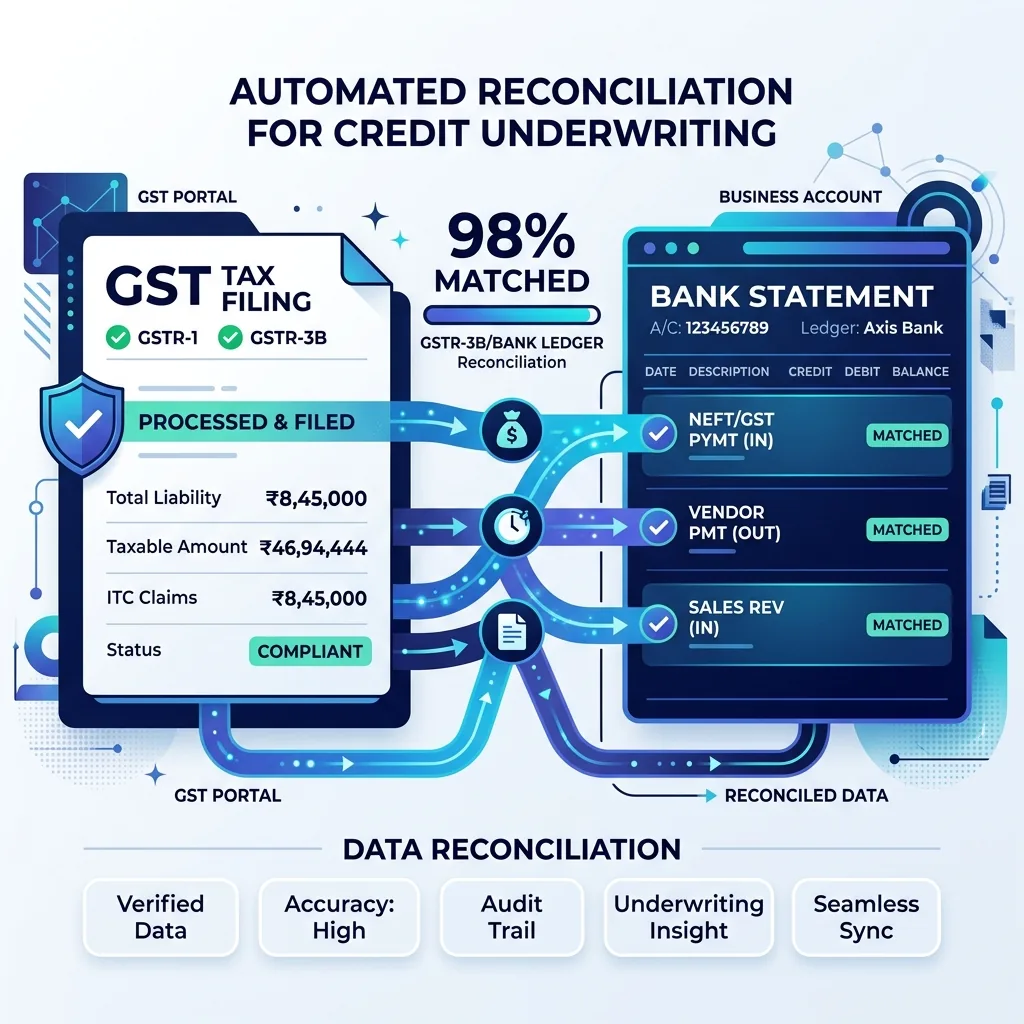
- Chartered Accountants & Forensic Auditors: Reconciling multi-year bank statements against tax filings, preparing statutory audit trails, and reconciling banking flows against GST returns. Read about GST and bank statement reconciliation.
- Debt Collection & Restructuring Teams: Evaluating a distressed borrower's active operational cash flow to design viable repayment schedules and assess real ability to pay.
7. How to Choose the Best Bank Statement Analyser in India (2026 Checklist)
Before selecting a statement analysis platform for your credit or finance team, evaluate prospective vendors against this essential evaluation checklist:
Buyer's Guide: For an in-depth evaluation framework and side-by-side feature comparison of top tools for Indian financial institutions, explore our guide on the best bank statement analyser in India.
8. Why CredTrace is the Industry-Standard Bank Statement Analyser
CredTrace was built specifically to solve the nuanced challenges of Indian financial data. From processing complex multi-column passbook scans to decrypting unique bank password algorithms and catching sophisticated PDF tamper patterns, CredTrace empowers underwriting teams to make confident credit decisions in seconds.
9. Frequently Asked Questions (FAQs)
What is an automated bank statement analyser?
A bank statement analyser is an AI-powered financial intelligence platform that extracts unstructured transaction data from PDF bank statements, normalizes multi-bank layouts, calculates critical solvency metrics (such as ABB, AMB, FOIR, and bounce ratios), detects financial fraud or tampering, and generates structured Credit Assessment Memos (CAM) in seconds.
How does an automated bank statement analyser work?
The analyser operates via a six-step pipeline: (1) Secure PDF ingestion and password decryption, (2) OCR and layout table parsing, (3) NLP transaction categorization, (4) Ledger arithmetic balance reconciliation, (5) Forensic fraud and circular transaction detection, and (6) Credit scoring and instant CAM report generation.
What financial metrics are calculated by a bank statement analyser?
Core metrics include Average Bank Balance (ABB), Average Monthly Balance (AMB), Fixed Obligation to Income Ratio (FOIR), Net Operating Cash Flow, inward/outward bounce ratios, salary credit regularity, cash withdrawal ratios, and counterparty concentration metrics.
Can a bank statement analyser detect tampered or forged PDF statements?
Yes. Advanced platforms like CredTrace examine PDF document metadata, vector layout coordinates, embedded font kerning discrepancies, and pixel-level modifications. It also validates mathematical ledger balance integrity (Previous Balance + Credits - Debits = Running Balance) across every transaction line item to catch edited numbers.
Why is an AI bank statement analyser better than manual Excel analysis?
Manual statement review takes 45 to 90 minutes per file and is susceptible to human calculation error and missed undisclosed debt. An AI bank statement analyser processes multi-page, multi-bank statements in under 15 seconds, detects complex circular transaction loops, flags tampered PDFs, and standardizes underwriting data across an entire lending institution.
Which Indian banks are supported by CredTrace bank statement analyser?
CredTrace supports 100+ Indian commercial, public sector (PSU), private, regional rural (RRB), and cooperative banks—including SBI, HDFC Bank, ICICI Bank, Axis Bank, Bank of Baroda, Kotak Mahindra Bank, and Punjab National Bank—with full support for password-protected, multi-column, and scanned PDF statements.
10. Conclusion & Next Steps
As digital lending moves toward algorithmic decisioning and borrower turnaround expectations shorten from days to minutes, manual document examination is no longer sustainable. A dedicated, AI-driven bank statement analyser safeguards credit portfolios against rising non-performing assets (NPAs), eliminates underwriting bottlenecks, and gives financial teams the deep cash flow clarity needed to make smarter, faster credit decisions.
Ready to modernize your credit appraisal workflow? Explore the CredTrace Bank Statement Analyser to see how automated statement parsing can revolutionize your lending operations today.